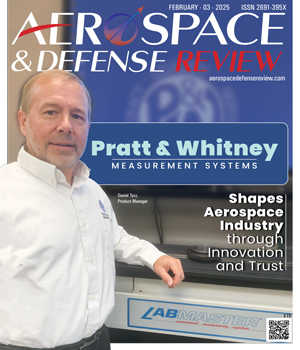
Pratt & Whitney Measurement Systems: Shapes Aerospace Industry through Innovation and Trust

Aerospace and Aviation Parts Distributors Company of the Year - 2025

Evolving geopolitical dynamics, rising demand for space-based assets and technological developments are fast driving the growth of the aerospace and defense industry. The global volatility and emerging space race has forced organizations to accomplish their mission faster than ever before. Companies that climb on the digital transformation bandwagon to adapt to the changing landscape will be well positioned to stay ahead of the market.

The global aerospace and defense market size is expected to reach $1234.42 billion by 2028, registering a CAGR of 5.8 percent. This growth is fueled by rising military expenditures, demand for air travel and developments in autonomous fighter jets. The production and maintenance of military equipment for the establishment of armed forces within countries is a key contributor. Aerial vehicles mounted with 8K video capture technologies offer imagery with superior detail.

Strategic partnerships between entities like government agencies, research institutions and private firms are opening new doors of opportunity for the expansion of defense technology cooperation. Joint development initiatives and technological advancements are set to push forward the growth of the aerospace sector.

In this edition of Aerospace and Defense Review, we explore the recent developments in the aerospace sector and how companies are on the track to leveraging the most promising aircraft solutions.

We feature insights from industry experts like Bob Zimering, Ph.D, Director Of Quality Assurance, Lockheed Martin, who focuses on the growing importance of cybersecurity in space operations, particularly satellites , uplinks, downlinks, crosslinks, ground stations and supply chains. We also showcase insights from Candace Givens, Sector Vice President Mission Assurance at Northrop Grumman. Givens highlights the rebirth of the space industry, driven by the reemergence of great innovation, design, solution expansion and exploration.

In this edition featuring the Aerospace and Aviation Parts Distributors and Aerospace Ultra-precision Metrology Instrument Supplier Company of the Year 2025, we aim to help you find the right partner for your business requirements.
    Aerospace and Aviation Parts Distributors Company of the Year

    ASAP Semiconductor
    ASAP Semiconductor is heralding a revolution in the challenging parts-procurement process. Since our formation in 2009, we have established ourselves as a solution-based systems integrator, well known to provide premiere custom-procurement, distribution, logistics, and project management solutions to customers ranging from major air carriers.

Avionics Info

Q1
What Do Top Avionics Solutions Companies Provide to the Aviation and Defense Industry?
Modern aircraft depend on avionics systems for navigation, communication, flight control, surveillance and cockpit visibility. Top Avionics Solutions providers develop and support the hardware, software and integrated systems that help pilots, operators and maintenance teams manage increasingly complex aircraft environments. The category spans commercial aviation, military platforms, business jets, unmanned systems and space applications. A weak avionics fit can create certification delays, maintenance complications or integration problems that surface long after deployment.
Q2
Why Is Demand for Top Avionics Solutions Increasing?
Aircraft operators are under pressure to improve safety, connectivity, fuel efficiency and fleet availability at the same time. Top Avionics Solutions are becoming more important as aircraft incorporate digital cockpits, advanced flight displays, satellite communications, cybersecurity protections and data-driven maintenance capabilities. Airlines, defense organizations and aerospace manufacturers are also dealing with stricter compliance requirements and growing data volumes. Most fleets already generate large amounts of information. The challenge is turning that information into decisions pilots, engineers and operators can actually use.
Q3
How Should Aerospace Organizations Evaluate Avionics Providers?
Technical specifications alone rarely tell the full story. Buyers usually look at certification history, integration experience, long-term support, repair capabilities and compatibility with existing aircraft systems. A useful evaluation exercise is reviewing how a provider handles software updates, component replacement cycles and regulatory documentation. An avionics platform may perform well in testing but create problems if spare parts, maintenance expertise or support access become difficult later. Aviation programs often remain active for decades, which makes lifecycle support a practical concern rather than a procurement detail.
Q4
What Business and Mission Value Do Avionics Systems Deliver?
Reliable avionics affect far more than cockpit functions. Better flight management can reduce fuel consumption, improve route efficiency and support safer flight operations. In military environments, avionics influence mission planning, situational awareness and communication reliability. Maintenance teams also benefit from systems that provide clearer diagnostics and fault reporting. A delayed component replacement can ground an aircraft. Better visibility into system health helps operators reduce downtime, avoid unnecessary inspections and manage maintenance schedules more effectively.
Q5
How Are Technology Trends Changing the Top Avionics Solutions Market?
Software-defined architectures, integrated modular avionics, cybersecurity protections, AI-assisted decision support and advanced connectivity are reshaping the market. Research and industry development efforts are focused on improving processing power, communication reliability, multicore computing and airspace awareness capabilities. At the same time, aircraft operators expect avionics systems to support future upgrades without requiring extensive redesign work. The strongest Top Avionics Solutions providers are increasingly judged on how well they balance innovation with certification requirements, safety standards and long-term maintainability.
Q6
What Should Decision-Makers Prioritize When Comparing Top Avionics Solutions?
Decision-makers should focus on aircraft compatibility, certification readiness, support infrastructure, cybersecurity protections and upgrade flexibility. It is also worth examining how providers handle integration with existing flight systems, maintenance workflows and communication networks. The most expensive option is not always the safest choice, and the lowest-cost option can create expensive retrofit work later. Top Avionics Solutions are typically evaluated on how reliably they perform in real flight conditions, how easily crews can operate them and how effectively support teams can maintain them throughout the aircraft lifecycle.